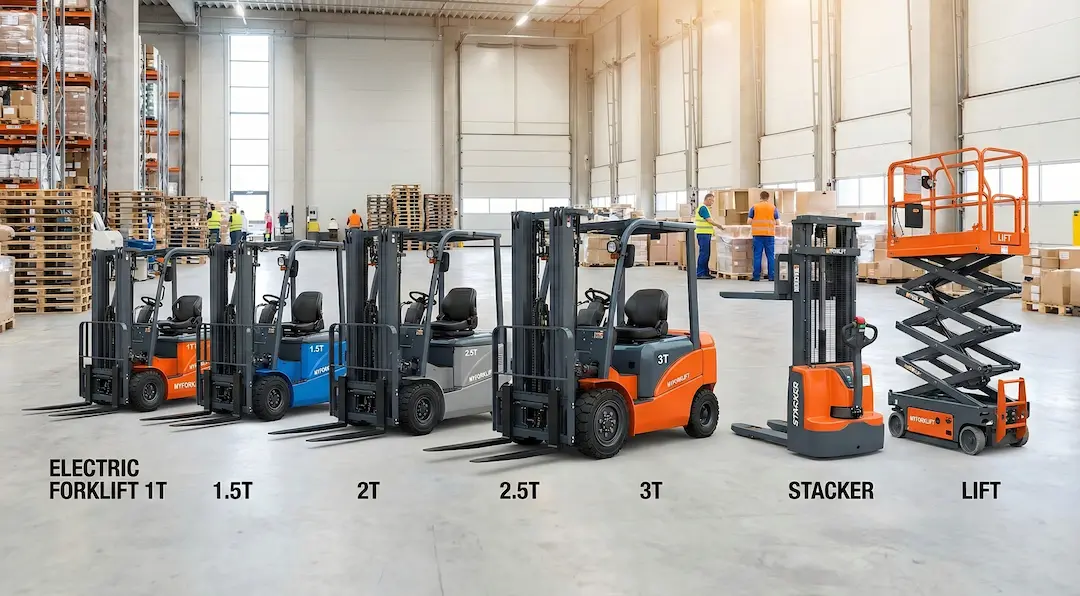
The Core Decision for US Importers and EU Distributors
Choosing between an electric forklift and a diesel forklift is a key purchasing decision for US importers and European distributors. The right option depends on operating environment, total cost of ownership, emission regulations, workload intensity, and long-term business strategy.
Across North America and Europe, electric forklifts are increasingly preferred for indoor warehouse and logistics operations due to environmental regulations and rising fuel costs. Diesel forklifts remain a practical choice for outdoor yards, construction material handling, and heavy continuous-duty applications.
💡 Industry Insight
Electric forklifts often deliver lower lifetime operating and maintenance costs because they have fewer mechanical components, require no fuel system servicing, and reduce downtime related to engine maintenance.
1. Electric vs Diesel Forklift — Quick Comparison
| Factor | Electric Forklift | Diesel Forklift |
|---|---|---|
| Best Application | Indoor warehouses, retail, logistics | Outdoor yards, construction, heavy-duty |
| Emissions | Zero (indoor compliant) | Produces exhaust emissions |
| Noise Level | Very low | High |
| Energy / Fuel Cost | Lower (electricity) | Higher (diesel fuel) |
| Maintenance | Low (battery, tires, electronics) | High (engine, transmission, fuel system) |
| Refueling / Charging | 6–8 hours (or opportunity charging) | 5 minutes refueling |
| Environmental Compliance | High (EU & US regulations) | Limited in indoor use |
2. Operating Cost Comparison (Total Cost of Ownership)
For fleet buyers in the United States and Europe, long-term cost efficiency is more important than upfront price.
Electric Forklifts — Lower Long-Term Cost
- Lower electricity cost compared to diesel fuel
- Minimal engine-related maintenance
- Longer service intervals
- Ideal for operations running 5+ hours per day
Diesel Forklifts — Lower Initial Cost
- Lower purchase price
- Higher fuel cost volatility
- Higher ongoing maintenance expense
- Better suited for remote outdoor sites without charging infrastructure
Buyer takeaway: Electric forklifts generally provide better ROI for warehouse fleets, while diesel forklifts remain practical for rugged outdoor work.
3. Environmental Regulations in the US and Europe
Environmental and workplace regulations increasingly influence purchasing decisions:
- EU Euro Stage V standards favor low-emission equipment
- US Tier 4 Final emission rules restrict diesel use in certain areas
- Indoor facilities and food logistics operations often require electric forklifts
If regulatory compliance or ESG goals matter, electric forklifts are the safer long-term investment.
4. Battery vs Diesel Fuel — Daily Workflow Impact
Electric Battery Options
- Lead-acid battery — Cost-effective for single-shift operations, requires watering and scheduled charging
- Lithium-ion battery — Maintenance-free, fast charging, ideal for multi-shift warehouses and high-uptime logistics centers
Diesel Advantage
- Fast refueling
- No charging infrastructure required
- Better performance for rough terrain, continuous outdoor duty, and heavy loads
5. Performance & Application Scenarios
Choose Electric Forklifts If You Operate:
- Indoor warehouses
- Retail & e-commerce fulfillment centers
- Food, pharmaceutical, or clean environments
- Emission-restricted urban areas
Choose Diesel Forklifts If You Operate:
- Outdoor yards and ports
- Construction material sites
- Mining or rough-terrain logistics
- Long continuous heavy-duty shifts
6. Common Forklift Buying Mistakes (B2B Buyers)
Avoid costly procurement errors:
- Ignoring warehouse door height and mast clearance
- Not matching charger voltage to local US/EU standards
- Over-specifying capacity and paying for unused power
- Failing to plan spare parts and after-sales service
Final Verdict — Which Forklift Should You Import?
- Choose Electric if your business focuses on indoor warehousing, logistics efficiency, sustainability, and lower long-term costs
- Choose Diesel if your operation requires rugged outdoor performance, remote fueling, or heavy continuous lifting
Both forklift types can be optimized through correct configuration — selecting the right model and supplier matters more than price alone.
Work With a Forklift Manufacturer Serving the US & Europe
If you are sourcing forklifts for the United States or Europe, choosing a supplier with OEM capability, stable production capacity, and export experience can significantly reduce purchasing risk.
Our factory supports custom branding, private labeling, bulk production, spare parts programs, and export-ready packaging. Whether you are a distributor, importer, or fleet operator, we can recommend a configuration that matches your load capacity, lift height, working environment, and budget.
📩 Contact our engineering team for a tailored recommendation and OEM quotation
Email: contact@jinli-machinery.com
WhatsApp: +86 18522164600